When you visit a store, office, or shopping center, you may not give much thought to the concrete curbs. Yet these simple features do a lot of work. They help guide traffic, manage rainwater, and protect paved areas from damage.
For new commercial sites, concrete curbing is an important part of the construction process. A well-built curb can help keep a property safe, neat, and easy to use.
At TNT Services, we know that good concrete work starts with careful planning and skilled crews. Our recent commercial curbing work in Fairview, Tennessee, offers a look at how we help prepare sites for years of use.
What Is Commercial Concrete Curbing?
Commercial concrete curbing refers to the concrete edges found along roads, parking lots, and other paved areas. These curbs help define where cars can drive, where people can walk, and where water should flow.
You can find concrete curbs in many places, including:
- Shopping centers and retail stores
- Office buildings and business parks
- Schools and public spaces
- Apartment complexes
- Parking lots and private roads
While curbs may seem like a small part of a large project, they serve several important purposes.
4 Benefits of Concrete Curbing for Commercial Properties
1. Helps Control Rainwater
Rain can cause big problems when water has no clear path to drain. It may pool on paved areas, wash away soil, or flow into places where it can cause damage.
Concrete curbs help guide water to drains and other planned outlets. When crews pair curbs with proper grading and drainage, they can help reduce standing water and soil erosion.
This is useful in Middle Tennessee, where heavy rain can put a site’s drainage system to the test.
2. Guides Traffic and Defines Spaces
A busy parking lot needs clear paths for cars and people. Concrete curbs help mark those paths.
They separate drive lanes from grass, define parking areas, and help guide cars through a site. Curbs also help protect areas that are not meant for vehicle use, such as lawns and planted spaces.
With the right layout, concrete curbing helps create a site that is easier to navigate.
3. Protects Pavement and Landscaping
The edges of paved areas can take a lot of wear. Cars may drive over them, rain can wash away nearby soil, and heavy use can cause damage over time.
Concrete curbs help form a firm edge along roads and parking lots. They can also help keep soil, mulch, and gravel in place.
This added protection may reduce the need for repairs and help the property stay in good shape.
4. Creates a Clean, Finished Look
Concrete curbing serves a practical purpose, but it also affects how a property looks.
Clean curb lines give parking lots, roads, and landscaped areas a neat, defined edge.
For new commercial sites, this helps create a more polished look once the work is complete.
How Power Curbing Machines Work
How Power Curbing Machines Work
One way crews install concrete curbs is with a machine called a Power Curber.
This type of equipment uses a process known as slipform curbing. Instead of setting up long rows of fixed forms, the machine shapes fresh concrete as it moves along a planned path.
Here’s how the process works:
- Crews prepare the site. They grade and compact the ground to create a firm base.
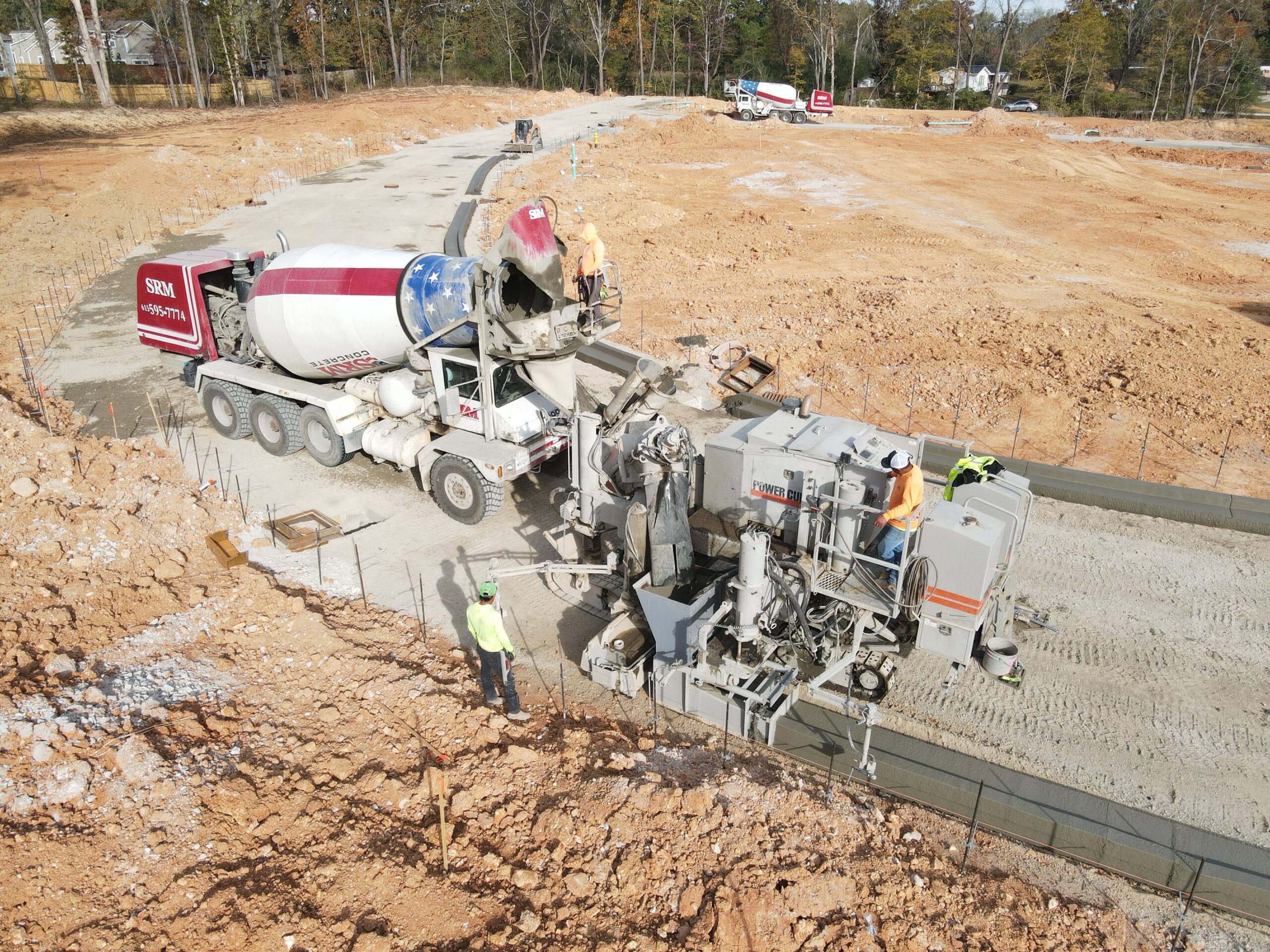
- Concrete arrives on-site. A concrete truck feeds the mix into the curbing machine.
- The machine forms the curb. As it moves forward, it shapes the concrete into the planned curb profile.
- Crews check the results. Workers monitor the curb’s shape, line, and finish as the work moves ahead.
- The concrete cures. The new curb needs time and proper care to gain strength.
Power curbing machines help crews place long, smooth runs of concrete with a consistent shape. This makes them a useful choice for large commercial sites.
A Look at Commercial Concrete Curbing in Fairview, TN
Our crew recently worked on concrete curbing at a commercial construction site in Fairview, Tennessee.
The aerial photo from this project shows the scale of the site. You can see the graded land, planned road areas, and concrete curbing taking shape.
The second photo offers a closer look at the work. A concrete truck feeds fresh concrete into a Power Curber while crew members guide and monitor the process.
These photos show how curbing fits into a much larger construction job. Each section of curb helps define the site’s layout and prepare it for the next steps.
Projects like this also show why the right tools and skilled crews matter. On a large site, crews must work with care to keep the curb lines and grades on track.
Why Proper Concrete Curb Installation Matters
A concrete curb needs more than a smooth finish to perform well.
The ground beneath it must be stable. The curb must follow the planned grade, and the design must account for how water will move across the site.
Poor site preparation or placement can lead to problems such as cracks, uneven curbs, or drainage issues.
That’s why it’s important to work with a concrete contractor who understands each step of the process.
At TNT Services, we provide concrete and sitework services for commercial projects across Middle Tennessee. Our work includes site preparation, grading, concrete installation, and other services that help move projects forward.
Frequently Asked Questions About Commercial Concrete Curbing
How long does concrete curbing last?
Well-built concrete curbing can last for decades. Its lifespan depends on the quality of the installation, soil conditions, drainage, traffic, and upkeep.
What is the difference between a curb and a curb and gutter?
A curb is a raised concrete edge. A curb and gutter system pairs that edge with a shallow channel that helps carry rainwater to drains or other outlets.
Why use a Power Curber instead of traditional forms?
A Power Curber can form long sections of concrete curb with fewer fixed forms. This can save time on large jobs and help crews maintain a consistent shape.
Can concrete curbing help prevent flooding?
Concrete curbing can help direct rainwater away from some areas. However, it must be part of a well-planned drainage system. Curbs alone cannot prevent all flooding.
When should concrete curbing be installed on a commercial site?
Crews often install curbing after the site has been graded and prepared, but before final paving. The exact order depends on the site’s design and construction schedule.
Commercial Concrete Curbing in Middle Tennessee
Concrete curbing may seem like a small part of a commercial site, but it does a big job. It helps guide traffic, control water, protect paved areas, and give the property a clean look.
From Fairview and Dickson to other parts of Middle Tennessee, TNT Services helps commercial projects take shape with dependable concrete and sitework services.
Planning a commercial concrete project? Contact TNT Services to discuss your needs and request an estimate.
